


Belgrade Serbia

Visiting Serbia has long been on my to-do list. Given its proximity to both Bosnia and Croatia, which I have visited many times, it’s a shame I haven’t gotten there sooner. Geo-politics sometimes have a knack of getting in the way. The NATO bombing campaign of the 1990s in response to Serb aggression in Bosnia and elsewhere made Serbia an unattractive destination for Americans. But Serbia’s aspirations to join the EU and its attempt to reintegrate into the European political mainstream have served to open the country up to tourism over the last decade.
Our visit to Belgrade coincided with a heat wave that left the thermometer hovering in the nineties most of the time we were there. In fact, the mighty Danube River, along which the city rests, has fallen to record low levels all along its course from Germany through Austria, Hungary, the Balkans and finally to the Black Sea at Romania. In Serbia falling water levels on the Danube have exposed, among other things, a mastodon skeleton and WWII-era Nazi warships, sunk to hinder oncoming Red Army forces from the east in 1944.

Belgrade’s history is marked by invasion and occupation, like many Eastern European cities. It was the site of a Roman settlement and subsequently the Byzantines controlled it for several centuries, bringing Orthodox Christianity to the Slavic Serb people. After a long Turkish occupation, in 1830 Serbia gained independence. The young Serbian kingdom was frequently at odds with the Ottomans Turks, and especially with Austria-Hungary, who viewed the new kingdom as a dangerous upstart. When Serbian terrorists assassinated the heir to the Austro-Hungarian throne in 1914 (in Sarajevo), World War I ensued. Austrian ships sailed down the Danube and shelled Belgrade, before occupying it until the war ended in 1918. Nazi Germany attacked the country in 1941, and Belgrade was occupied by Axis forces until it was liberated in the fall of 1944 by the Red Army and Yugoslav partisans led by the charismatic leader Tito.
Special mention should be made of the role Russia has played in Serbian history. Few peoples in Europe have been as close as the Russians and the Serbs. The two share a tight and uncommon bond due to their shared religion (Eastern Orthodox) and because of the closeness of their languages (Russian speakers can understand a good deal of the Serbian language). Most importantly, Russia has served as the historical protector of the Serbian people, particularly over the last two centuries (against the Turks, the Austrians and Hungarians, and of course the Nazis). Early in the twentieth century the Serbian King Alexander was the godson of the Russian Tsar Nicholas II (he studied in Russia as a young cadet). Even during the civil war in Yugoslavia in the 1990s Russia took the side of Serbia, at one point even occupying an airfield to hold for the Serbs in Kosovo before NATO forces could occupy it. When we were in Belgrade, we spoke Russian for much of the time and saw a number of Russian tourists around the city. I felt more comfortable being identified that way than as an American, though today most Serbs hold no grudge against the United States.
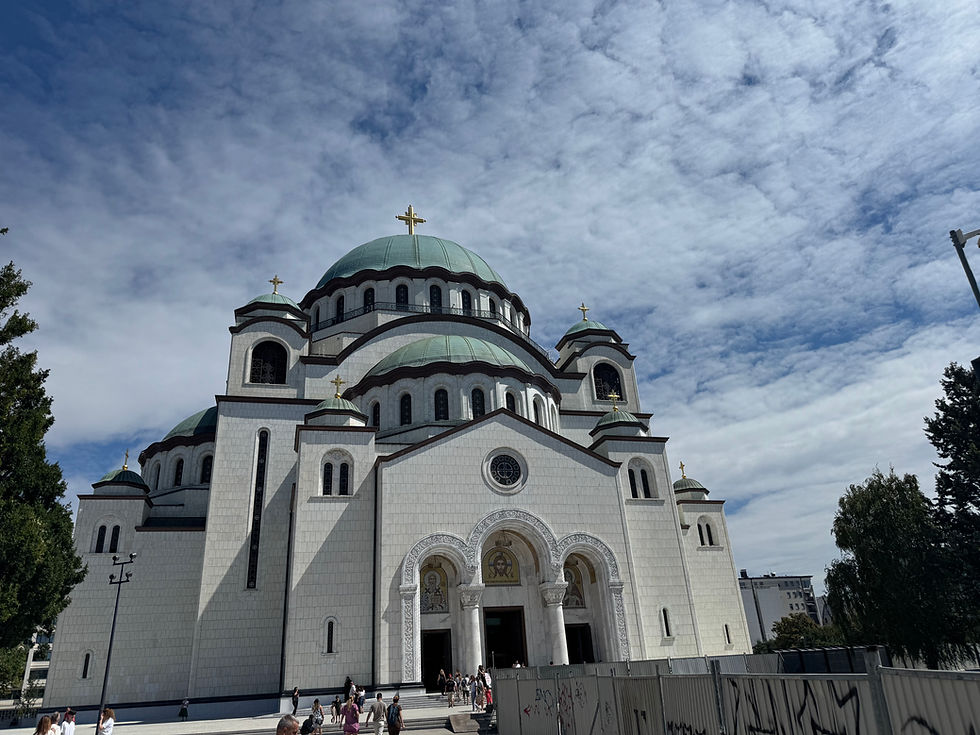
Today Belgrade offers all the charm and amenities of any major European city. The city is modern and offers little in the way of older, classical architecture, but its location along the Danube River adds charm, and there are many excellent restaurants. There were several interesting historical sights. One of the most impressive for us was the massive Orthodox cathedral Saint Sava, named after a man considered to be the patron saint of the Serbian Orthodox Church. It is a new church, but its massive size and opulent interior make up for its lack of history. Its soaring ceilings and mosaic work are sights to behold.

We will definitely return to Serbia, to explore some of the sights in the south of the country, which we were unable to see on our short visit, which was a prelude to our trip to Moscow.
#austinauthor #jodyferguson #belgrade #danuberiver #serbia #orthodoxchurch #yugoslavia


Comments